Why AI agent pilots stall at the governance stage
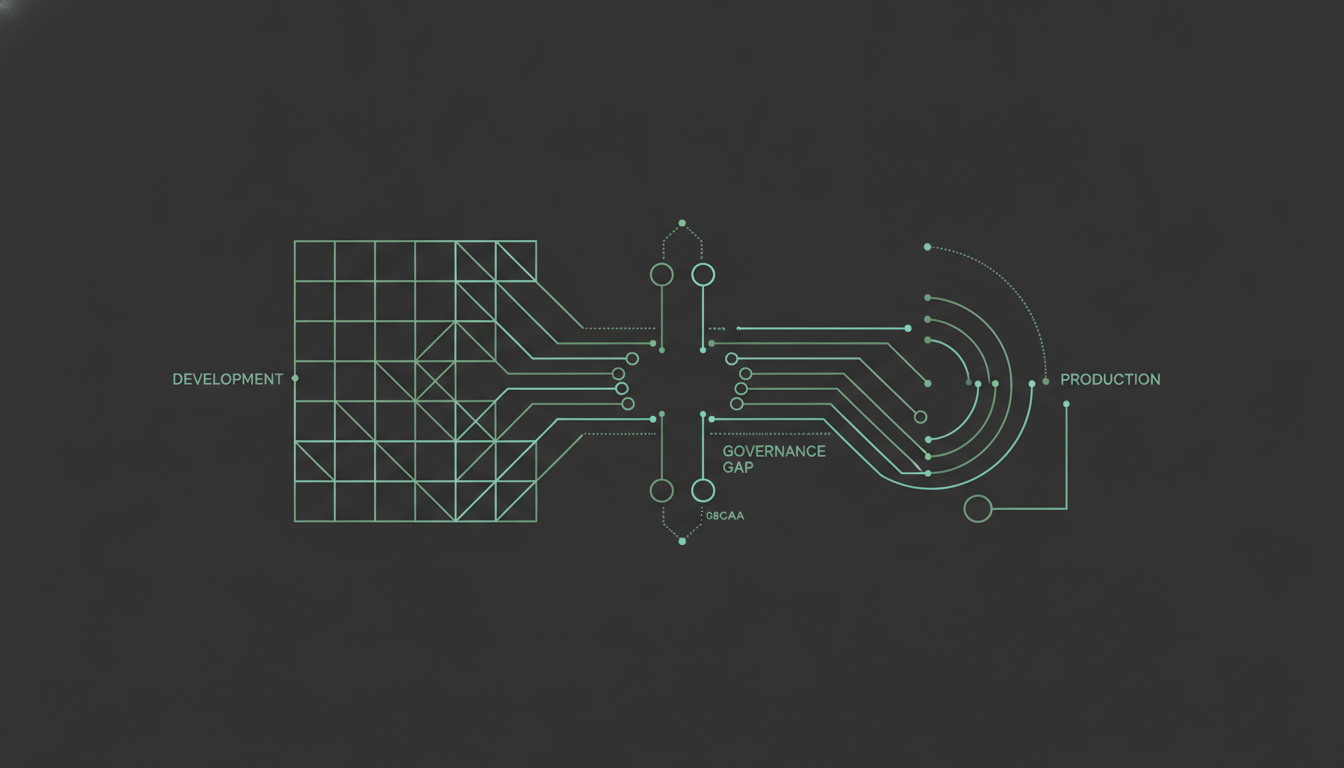
What separates the pilots that ship from the ones that stall
Getting an AI agent into production is not primarily a technical problem. The architecture decisions, the framework choices, the prompt engineering, those are solvable with enough iteration. What ends pilots before they ship is the gap between what the agent can do in a sandbox and what your organisation is prepared to govern in production.
Getting your first agent live requires passing through a set of gates that have nothing to do with model quality: access controls, audit logs, cost ceilings, escalation paths, and a clear answer to the question “who is responsible when this agent does something unexpected?” Teams that build the agent first and answer those questions later hit those gates unprepared.
The numbers are sharp. Only 12% of enterprise AI agent pilots reach production deployment, and separately, Gartner projects that 40% of enterprise agentic AI projects will be canceled by end of 2027, with governance frameworks, observability gaps, and token cost explosions named as the causes. These are not the same failure mode, but they share a root: governance treated as a compliance layer to add at the end, rather than a set of preconditions to establish at the start.
What governance actually means for an agent in production
AI agent governance is not a policy document. It is a set of runtime controls that determine what the agent can access, what actions it can take without human approval, how much it can spend per hour, and what happens when it encounters a situation outside its defined scope.
A useful way to frame it is four categories of control:
- Identity and permissions. Which systems can the agent authenticate to, with what credentials, and at what privilege level. An agent that can read a database is a different risk profile from one that can write to it. RBAC and ABAC models for agents handle this differently depending on how dynamic the permission requirements are.
- Observability. Every action the agent takes, every tool call, every external API request, needs a log entry that a human can read. Without this, you cannot debug failures or satisfy an audit. Agent observability is the precondition for everything else.
- Cost controls. LLM inference at scale costs real money. An agent running an uncontrolled loop can consume thousands of dollars of tokens in an hour. Token budgets and circuit breakers are not optional at production scale.
- Escalation and override. When the agent encounters a case outside its confidence boundary, what happens? A defined escalation path, reviewed and signed off before go-live, is what distinguishes a production agent from an experiment.
flowchart TD
    A[Agent receives task] --> B{Within permission scope?}
    B -- No --> C[Escalate to human]
    B -- Yes --> D{Within token budget?}
    D -- No --> E[Pause and alert]
    D -- Yes --> F[Execute action]
    F --> G{Outcome logged?}
    G -- No --> H[Block and flag]
    G -- Yes --> I[Task complete]
Where pilots break down
The pattern that ends most pilots is not a single failure. It is the accumulation of deferred decisions surfacing at the production review.
The team builds an agent that works well in staging. It handles the target task, the outputs look good, the demo goes well. Then the security review asks for an audit log. There is none, or it is incomplete. The finance team asks for cost projections under production load. Nobody modelled this. Legal asks what happens when the agent takes an action that is later disputed. There is no documented escalation policy.
Each of these is fixable in isolation. Together, they add weeks or months to a deployment timeline, and many teams do not recover. The 2026 CIO reporting on governance frameworks as a prerequisite for AI agent scaling is explicit: the framework must precede scaling, not follow it.
The deployments that succeed tend to look different from the start. JPMorgan Chase built LLM Suite as an internal platform supporting 200,000 employees across 450 AI use cases in daily production, with an $18 billion annual technology budget backing the infrastructure. That is not an accident of scale. It reflects an organisation that treated access control, auditability, and cost management as first-class requirements, not afterthoughts.
Contrast that with Klarna, whose customer service agent handled 2.3 million conversations in its first month and resolved two-thirds of tickets, cutting resolution time from 11 minutes to 2 minutes. The result was genuine and the economics were real. But the public account of what followed is instructive: moving fast in production without sufficient governance around escalation and quality control created problems that required significant remediation. The agent worked. The governance around it needed to catch up.
The decision that determines whether you ship
flowchart TD
    A[Pilot passes internal testing] --> B{Governance baseline defined?}
    B -- No --> C[Define: identity, permissions, observability, cost controls, escalation]
    C --> D{Stakeholder sign-off?}
    D -- No --> E[Resolve open questions]
    E --> D
    D -- Yes --> F[Production deployment]
    B -- Yes --> D
    F --> G[Monitor and iterate]
The decision point is not whether to add governance. It is whether to define it before or after the first production deployment. Teams that define it before move through the security, compliance, and finance review gates in days. Teams that define it after spend weeks in remediation, if they finish at all.
Implementing agent observability and governing agentic AI are not late-stage concerns. They are the conditions under which a production deployment is permitted to exist.
Uber’s engineering organisation reached 84% daily active use of agentic coding tools by early 2026, with agents generating 65 to 72% of all code written in their IDEs. That adoption rate is only possible with governance infrastructure underneath it: clear policies on what agents can do, audit trails for generated code, and cost controls on the underlying inference. Without those, the risk surface would have forced a slowdown.
For teams building their first production agent, the ai governance framework does not need to cover every edge case on day one. It needs to cover the four categories described above well enough to pass a reasonable security and compliance review. Tools like Prefactor exist specifically to evaluate agents in real time as they run, which covers the monitoring and audit evidence a review asks for without building the entire infrastructure from scratch.
The AI governance best practices that apply to enterprise-scale deployments apply, in simplified form, to a team shipping its first agent. The questions are the same. Only 21% of organisations currently have mature governance models for autonomous agents, which means the majority of teams entering production for the first time are doing so without the controls in place. That is the gap Gartner is measuring.
If you are evaluating your AI agent architecture decisions now, the right question is not “does our agent work?” It is “can we govern it in production?” The answer to the second question determines whether the first question ever matters.
Where to start
If you are preparing your first production deployment, the most useful immediate step is an honest assessment of where your governance baseline sits today. Take the agent readiness assessment to identify which of the four control categories, identity, observability, cost, and escalation, need work before you hit a production gate.
 Matt DoughtyCEO & Co-Founder, Prefactor
Founder of Prefactor, writing on the operational reality of getting AI agents into production — evaluation, observability, governance, and the plumbing assistants never needed.